
Lessons from Shopify’s Bold “AI‑First” Hiring Directive
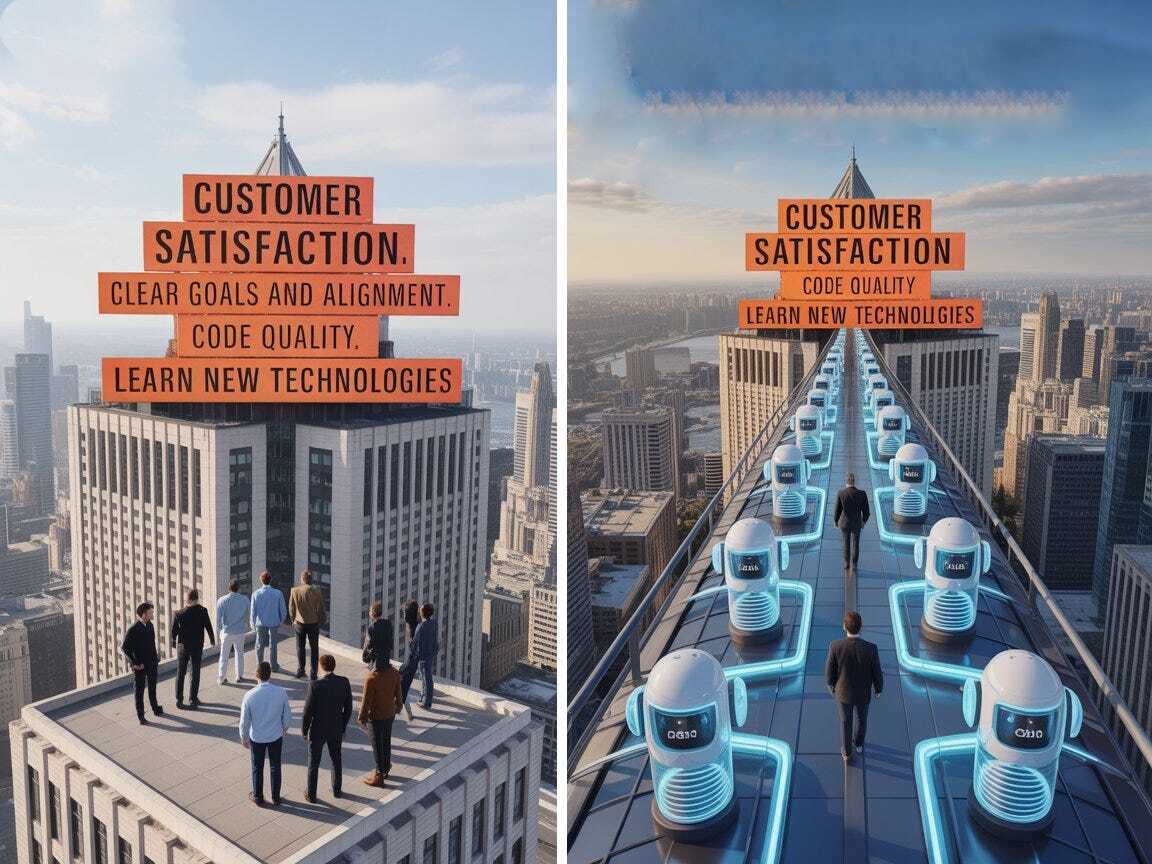
“Before asking for more Headcount and resources, teams must demonstrate why they cannot get what they want done using AI.”
—Tobi Lütke, CEO, Shopify 1
I imagine that single line, tucked into an internal memo, ricocheted through tech Slack channels faster than a leaked product roadmap. At first glance, it appears to be ruthless cost-cutting: outsourcing work to algorithms and reducing payroll. But step back and you’ll see something bigger. Lütke is planting a flag in the ground that says: the future of work belongs to people who can partner with AI agents.
The Real Story: A Widening Skills Chasm
For several years, the “AI skills gap” has been spoken about in polite, theoretical tones, almost like technical debt used to be discussed—real, but safely distant. That distance is gone. The World Economic Forum reports that 75 percent of firms expect to integrate AI tools into training by 2025, yet two‑thirds admit they lack the in‑house expertise to make those tools productive. 2 In other words, they’re standing at the edge of a widening chasm with no bridge yet built.Crucially, this gap isn’t a single missing credential. It is complex, layered:
-
Technical Fluency. Knowing the building blocks—data literacy, prompt engineering, AI agent frameworks, and hooks into LLM APIs.
-
Strategic Judgment. Deciding where agency creates leverage and where human insight still matters.
-
Collaboration. Pragmatically onboard agents as teammates to contribute engineering, insights, and analyses, then refine their output rather than discarding or rubber‑stamping it.
Reading Lütke’s memo reveals that Shopify doesn’t allow employees to ignore those layers. Mastery of AI is now a baseline expectation embedded in performance reviews.1 Lutke not only indicates his daily use of AI but also Shopify’s commitment to enabling all employees to access AI tools and learning.
What about in your organization? Will you slow down as the gap becomes visible? Doing nothing will leave you stranded when it's time to cross the chasm.
The Hidden Cost of Doing Nothing
Entry‑level roles—the traditional on‑ramps into tech—are evaporating. A fine-tuned language model can automate tasks that once served as apprenticeships (test engineering, fixing low-priority bugs, ingesting data into dashboards). If companies can shave months of grunt work off a project, they will; if they can reduce headcount, boards will reward them.Left unchecked, we get an AI oligarchy: a handful of companies and countries with proprietary agent frameworks, LLM stacks, and the talent who know how to wield them. Everyone else is left on the sidelines, watching teams cross the chasm on the bridges they’ve built, hoping for a chance to follow.
This isn’t a dystopian inevitability, but the trajectory is clear. Those who fail to reskill risk not just unemployment, but unemployability in entire swaths of the new economy.
Agents as Bridges, Not Axes
Here’s the twist that keeps me optimistic: the same AI agents that threaten to automate us can become personalized mentors, helping us outrun obsolescence. Today’s agent frameworks can: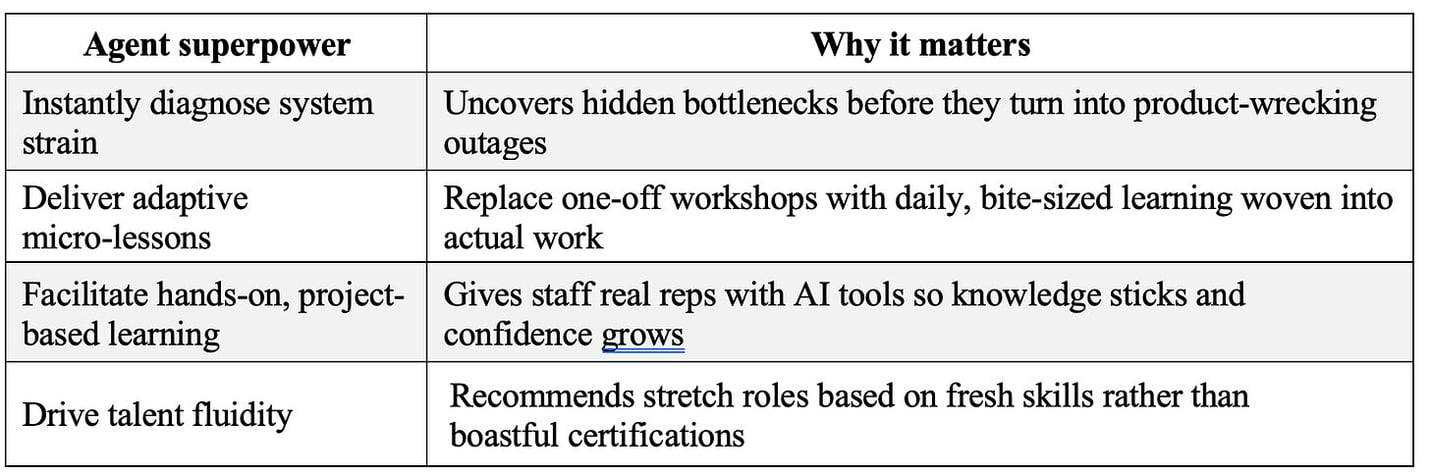
Four Moves to Start Today
- Launch a Dojo (Internal L&D). Don’t rely on two-day classes and occasional lunch‑and‑learns for upskilling. Build upskilling centers that blend learning by doing, design thinking, and AI agent collaboration. Dig into The Dev Manager’s Playbook YouTube channel for strategies for onboarding AI agents. Make continuous learning part of the organizational culture.
- Embed Learning in Tools People Already Use. For example, incorporate AI-powered test automation into your pipelines that integrate micro-feedback loops into Slack. The results: learning sticks when it happens in the flow of work, not outside it, yielding significant product improvements.
- Reward Skill Development Publicly. Making skills, applied, a visible path to career growth. Recognition beats fear as a motivator.
- Proactively addressing equity and access. Ensure that upskilling opportunities are available to all, not just the privileged few.
Beyond Compliance—Toward Competitive Edge
Some critics dismiss Shopify’s policy as a blunt instrument, arguing that “you can’t simply decree innovation.” True, but history favors companies willing to set audacious constraints. The iPhone was born from “one‑hand operation; no stylus.” Spotify’s innovative audio compression and delivery were driven by “bandwidth limitations and the prevalence of slow internet connections.” Constraints force creative leaps.By refusing to add headcount until AI is ruled out, Shopify forces each team to run controlled experiments to build, measure, and document learned experiences. Whether every experiment succeeds is irrelevant; the meta‑skill of rapid AI evaluation becomes ingrained across the organization.
The Takeaway for the Rest of Us
Lütke has thrown down a gauntlet. I urge you to disregard the media headlines reporting this event and instead read his internal memo. 1 You don’t need to copy Shopify line by line, but you can’t ignore the signal. The next promotion, the next raise, perhaps even the next job interview will hinge on your answer to a simple question: “Tell me of a time when you and an AI agent delivered something neither of you could do alone.”My advice, use agents as bridges—accelerating learning, amplifying creativity—to widen, not narrow, the circle of opportunity. But the clock is ticking. The chasm between AI‑fluent and AI‑fearful grows wider every quarter day.
So pick up the gauntlet. Ask yourself, “Am I better at my job than an AI agent?” Learn how to partner with an AI teammate. Form a plan to leap the gap together before it becomes too wide to cross. Dig into The Dev Manager’s Playbook YouTube channel for strategies for onboarding AI agents to your team.
Bibliography
1 Lütke, Tobi. 2025. AI usage is now a baseline expectation. March 20. https://x.com/tobi/status/1909231499448401946/photo/1.2 Blog, The Artha. 2025. Mind the (Skills) Gap : Insights from the WEF Report. February 14. https://arthalearning.com/mind-the-skills-gap-insights-from-the-wef-report/.